What is Worlding?
A world is not a collection of things. It is an unfolding through relationship of the various layers of existence that are constantly mutually shaping one another. It is ongoing, complex, dynamic, and adaptive. And it is this process of unfolding through relationship, that I am calling worlding. It is the way realities, material, social, ecological and otherwise come into being.
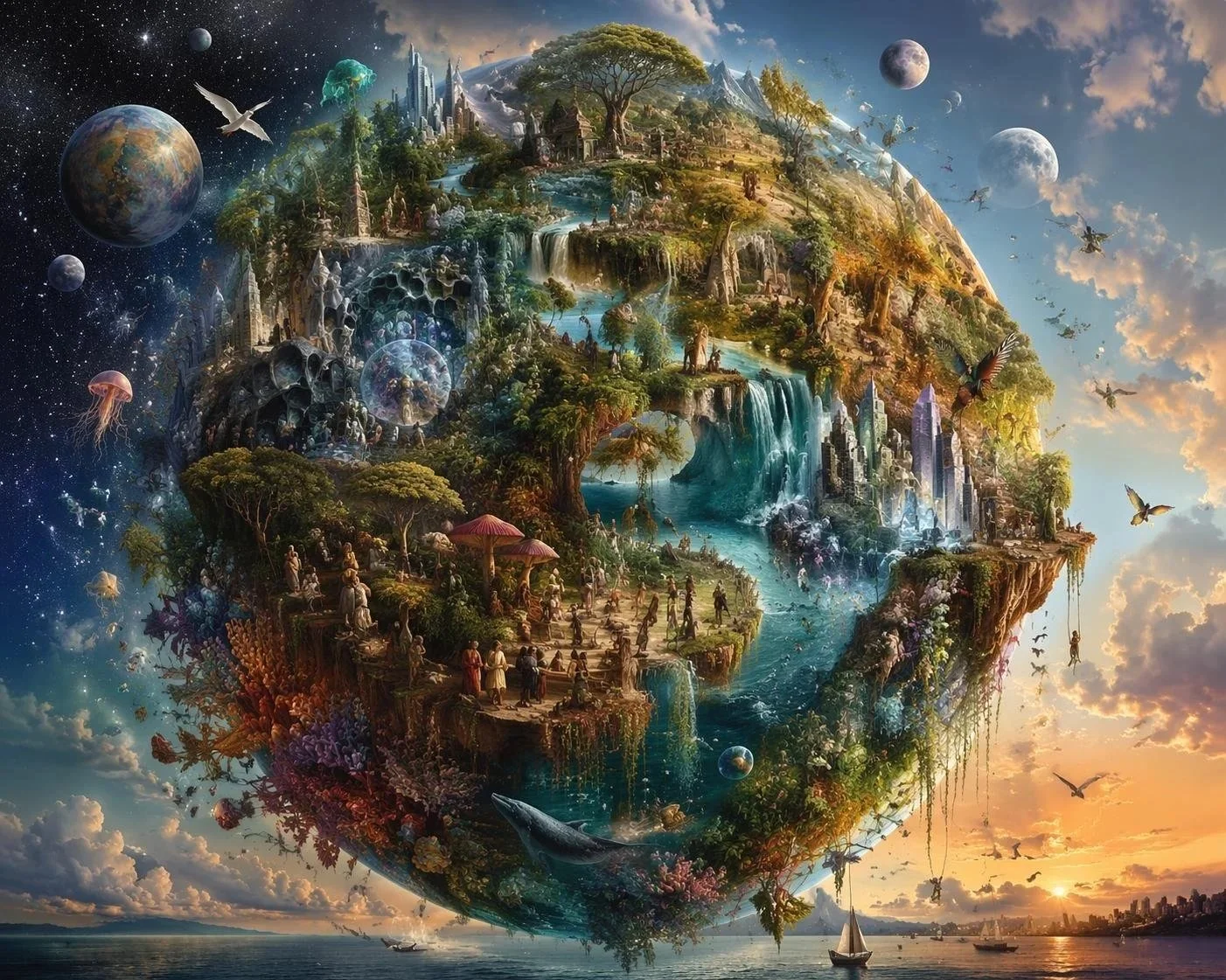
The (On-going) Beginning of a Thesis
The late anthropologist David Graeber wrote, “The ultimate, hidden truth of the world is that it is something that we make, and could just as easily make differently.” Below is the capstone presentation for my Master’s degree in Mindfulness-Based Transpersonal Counseling Psychology. Weaving in my experience in systems anthropology and strategy, this presentation is a process of critical, creative, and exploratory inquiry into what makes a world, and why it is important and what it takes to engage in this process consciously.
By weaving together insights from complexity science, mystical and esoteric traditions, neuropsychology, Indigenous wisdom and imagination, contemporary psychological frameworks, critical feminism, anthropology, Buddhism, and the work of researchers and thinkers beyond conventional categorization, this presentation seeks to illuminate multiple dimensions of worlding. It ultimately asks: what forms of worlding are being called for in a time when life on Earth faces increasingly complex challenges, and what role might mental healthcare play within this process?
Following the alchemical axiom “As above, so below,” the author engages in a non-linear exploration of correspondences between the macrocosm of society and the microcosm of the inner world. This approach invites us to liberate our imaginations and engage in sentipensar (feel-thinking) as a pathway toward cultivating more compassionate worlds.